

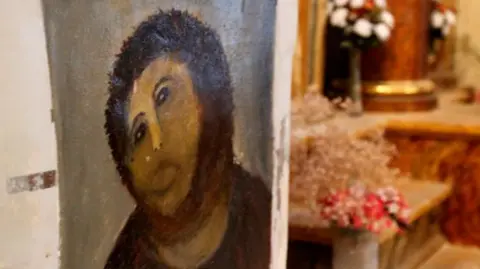
The elderly woman from Spain who made international headlines for her infamous restoration attempt on a cherished Jesus Christ fresco has passed away at the age of 94.
The woman, a resident of the town of Borja in northern Spain, rose to prominence thirteen years ago after she undertook to repaint a century-old painting known as Ecce Homo housed within her local church.
Giménez's restoration effort spread across the internet and earned the moniker "Potato Jesus", largely due to the resulting likeness of Christ's head looking somewhat like a furry primate.
Local Confirmation and Tribute
The 94-year-old's death was announced by Borja's mayor, Eduardo Arilla, in a social media post, where he described her as a "passionate lover of painting from a very early age".
"Rest in peace Cecilia, we will always remember you," the mayor posted.
Arilla further referenced Giménez's "famous restoration of Ecce Homo" in the summer of 2012, which "because of the deteriorated condition it presented, Cecilia, with the best intentions, chose to apply new paint over the original".
The Artwork's History and the Now-Infamous Intervention
The Ecce Homo ("Behold the Man" in Latin) painted by nineteenth-century painter Elias Garcia Martinez had been held for over a hundred years in the Sanctuary of Mercy Church near Zaragoza.
At the time, Giménez, then 81, stated that church members had "always repaired everything here", and that she had been given the go-ahead from the local priest to do the work.
She added at the time that anyone who entered the church would have observed she was applying paint to the original image.
An Unexpected Economic Lifeline
The aftermath of the repaint job spawned the "Monkey Christ" internet phenomenon and transformed the once quiet town of Borja rapidly turn into a significant visitor attraction.
The town, which had previously seen only five thousand tourists per year, received more than 40,000 tourists by 2013, and generated more than €50,000 for charity from the interest.
Today, local authorities estimate that between 15,000 and 20,000 tourists visit Borja each year to view the famous portrait, which is now protected by a protective shield of glass.
Legacy and Local Admiration
After recovering from the wave of criticism, with support from local residents and others around the world, Giménez went on to hold an art exhibition featuring twenty-eight of her personal works.
She was commended by Borja's mayor for her generosity and decades of faithful service to the church.
In the end, what began as a well-intentioned but unsuccessful art repair forged an unlikely cultural icon and provided unprecedented attention and resources to a humble Spanish town.


